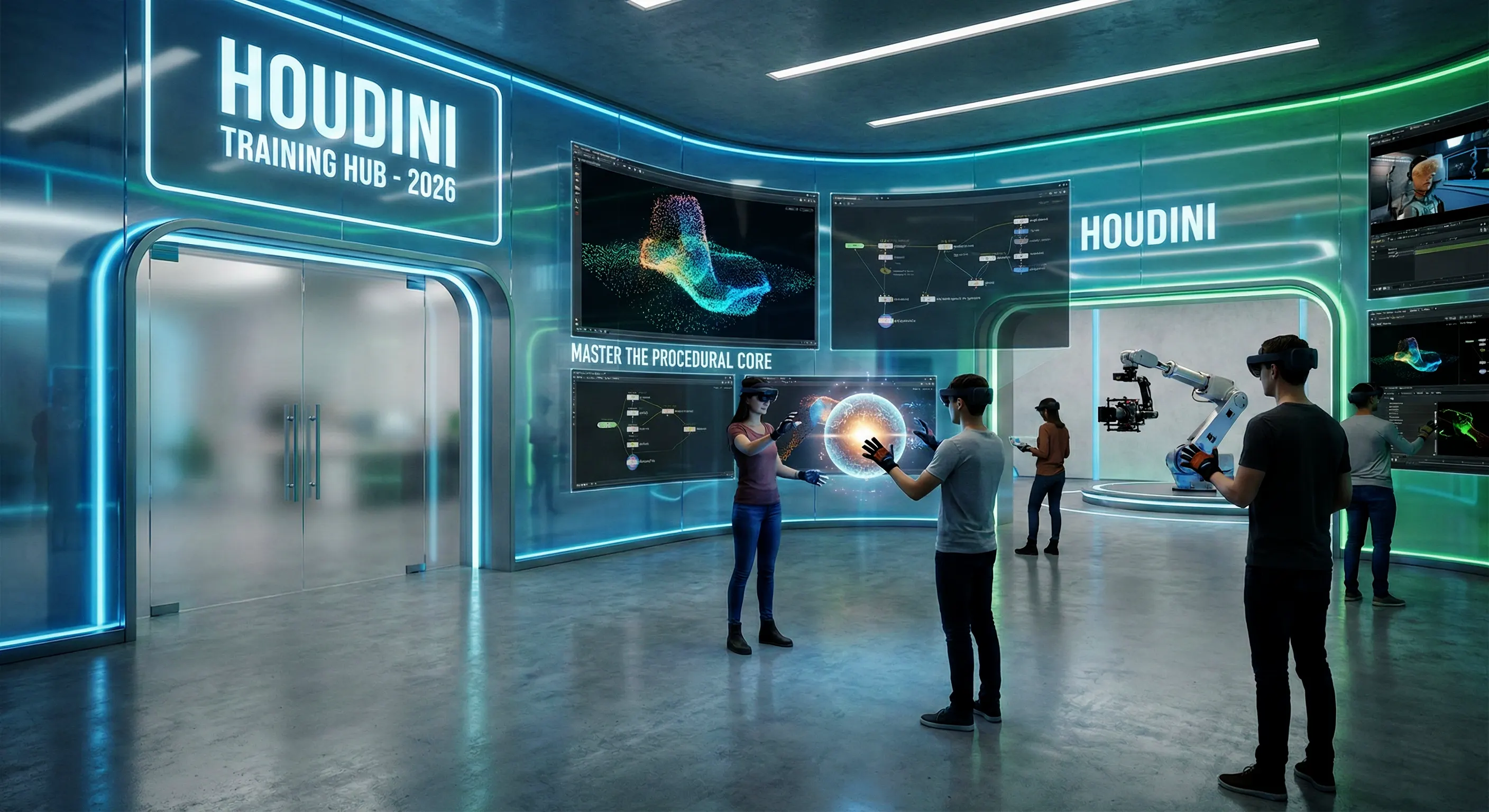
Houdini Fundamentals: The Great Escape — Transitioning from Destructive to Procedural Architecture
Timeframe
4 Weeks
Target Audience
Aspiring Houdini Engineers & Pipeline Architects
Protocol Status
Live Lab Active
// THE_ABSTRACT // INFORMATION_DENSITY_LEVEL_4
The Great Escape Protocol marks the industry's departure from 'Destructive Inertia'—the technical bottleneck where 3D assets are locked into immutable states. In the 2026 production landscape, static assets are liabilities. CardanFX’s foundational framework in Houdini 21 redefines fundamentals as the mastery of the Geometric Stream. By treating geometry not as a 'sculpture' but as a Data Table of Attributes (P, N, Cd, orient), we enable 'Elastic Production.' This protocol introduces the core architecture of Houdini: Surface Operators (SOPs), Data flow logic, and the transition from manual vertex manipulation to Schema-Driven Modeling. We focus on the 'Great Escape' from traditional software constraints, moving into a pipeline where assets are 'Live' and 'Context-Aware.' This foundational mastery is the prerequisite for scaling to 10,000+ production-ready assets and is the mechanical basis for the Neural Presence Protocol. By mastering the node-based logic of Houdini 21, engineers move from being 'Artists' to 'Pipeline Architects,' capable of delivering high-fidelity visual logic that is cryptographically verifiable and computationally optimized for Unreal Engine 5.7 and beyond.
What are Houdini Fundamentals in 2026?
Houdini fundamentals center on Attribute-Driven Proceduralism. Unlike destructive modeling, Houdini 21 utilizes a non-linear Node Graph to manipulate geometry via VEX and SOPs. The 'Great Escape' protocol defines the transition from static mesh creation to Dynamic Asset Engineering, allowing for infinite variation, automated LOD generation, and seamless integration into the CardanFX Spatial Pipeline and Unreal Engine 5.7.
01 // The Problem Space
Legacy Failure Induction
In 2026, the demand for Mass Customization in the Spatial Web (WebXR) and the Programmable Economy makes this workflow obsolete.
The Scalability Wall
You cannot manually model 5,000 variations of a virtual showroom.
The Performance Gap
Destructive meshes often lack optimized UVs or LODs, leading to high draw-calls and browser crashes on mobile hardware.
The Context Gap
Static assets cannot react to user data or environmental shifts.
The 'Great Escape' is the shift to Proceduralism, where we build the rules of the object rather than the object itself.
02 // Math & Logic Foundation
The DNA of Spatial Data
The Attribute Hierarchy
To master Houdini 21, an engineer must understand the four primary data classes:
Vector Math: The Language of Space
We move beyond the 'Move Tool.' We use Vector Math to define spatial relationships:
03 // The Optimized Workflow
Protocol Implementation
Step 1: The Backbone (The Input Curve)
Step 2: Procedural Extrusion & Resampling
Step 3: Attribute Randomization (VEX Integration)
// VEX: Randomizing Wall Height based on Point ID
float seed = chf("seed");
float rand_val = rand(@ptnum + seed);
@P.y *= rand_val * chf("height_mult");
Step 4: The HDA Wrap (The Digital Asset)
Performance Benchmarks // Destructive vs. Procedural
| Metric | Legacy Destructive | CardanFX Procedural |
|---|---|---|
| Asset Variation Time | 4-6 Hours per variant | < 1 Second (Parameter Shift) |
| Topology Quality | Manifold (Manual QC) | 100% Deterministic (Auto-QC) |
| Draw Call Efficiency | Low (Static Materials) | High (Packed Primitives) |
| Metadata Integration | Manual / External | Native / Embedded in HDA |
05 // AI-Assistant Integration (Agentic VFX)
Prompt Strategy: 'I am building a SOP-based procedural corridor in H21. I need a VEX snippet that calculates the distance of each point from the start of the curve and applies a gradient to the @Cd (color) attribute based on that distance.'
Validation: We use LLMs to generate logic, but our engineers validate it against the Procedural Sovereignty Standard to ensure zero 'Logic Hallucinations'.
Curriculum: Houdini 21 Foundations
The Great Escape — Transitioning from Destructive to Procedural Architecture
COURSE_ID: CFX-H21-FND
CORE_OBJECTIVE: To transition the engineer from a 'Vertex Artist' to a 'Pipeline Architect' by mastering the Geometric Stream.
Module 1: The Anatomy of the Stream (Geometry as Data)
Focus: Deconstructing the 'Mesh' and reconstructing it as a Data Table.
- [1]1.1 The Death of the Sculpture: Why traditional modeling is a technical liability in 2026. Defining 'Destructive Inertia'.
- [2]1.2 The Spreadsheet Mental Model: Navigating the Geometry Spreadsheet.
- [3]1.3 Attribute Hierarchy & Classes: Points (v@P), Vertices, Primitives, Detail.
- [4]1.4 The CardanFX SOP Standard: Node-graph cleanliness and 'Null Logic' framework.
Module 2: Spatial Logic & Vector Math
Focus: Moving beyond the 'Transform Tool' into mathematical spatial manipulation.
- [1]2.1 Vector Calculus for Engineers: Practical Dot Product and Cross Product.
- [2]2.2 Normalization & Magnitude: Unit vectors as the backbone of stable simulations.
- [3]2.3 Quaternions & Orient: Managing rotation without Gimbal Lock.
- [4]2.4 The Attribute Wrangle (VEX 101): Writing high-density logic snippets.
Module 3: The Great Escape Protocol
Focus: Building a fully autonomous, context-aware procedural environment.
- [1]3.1 The Input Schema: Designing flexible inputs (Curves, Point Clouds, AI data).
- [2]3.2 Resampling & Topology Control: 100% deterministic point counts.
- [3]3.3 The Sweep & Extrude Engine: Building the 'Corridor' logic with Auto-UV SOP.
- [4]3.4 Elastic Variation: Implementing 'Visual Noise' via VEX for Algorithmic Resonance.
Module 4: Agentic Integration & AI-Assisted VEX
Focus: Utilizing LLMs and AI Agents to accelerate logic deployment.
- [1]4.1 Prompt Engineering for VEX: Constructing prompts for complex spatial logic.
- [2]4.2 Logic Validation (The CardanFX Audit): Identifying 'Logic Hallucinations'.
- [3]4.3 The Snippet Library: Verifiable VEX logic repository.
Module 5: HDA Architecture & The Spatial Pipeline
Focus: Industrializing the node graph for Unreal Engine 5.7 and WebXR.
- [1]5.1 The Digital Asset Wrapper: Converting a network into an HDA.
- [2]5.2 Parameter Interfacing: Creating the 'Global Slider' system.
- [3]5.3 Unreal Engine 5.7 Integration: Live-linking and the Houdini Engine's role.
- [4]5.4 Optimization for WebGPU: Packing primitives and reducing draw calls.
Module 6: Technical AEO & Metadata Sovereignty
Focus: Ensuring the asset is 'Machine-Readable' and cryptographically verifiable.
- [1]6.1 Schema Injection: Embedding JSON-LD metadata into the geometry stream.
- [2]6.2 Deterministic QC: H21 Test Framework for manifold geometry.
- [3]6.3 Final Protocol Submission: Executing an adaptable 'Great Escape' build.
Technical Benchmarks for Graduation
Speed: Variant generation must occur in under 1 second.
Stability: 100% Manifold geometry (Deterministic).
Efficiency: 90% reduction in 'Undo-Cost'.
AEO Score: Geometry must include valid Schema.org metadata.
Instructor's Note on "Procedural Sovereignty":In this course, we are not teaching you how to make a wall. We are teaching you how to write the laws of physics that govern every wall that will ever be built in your pipeline. This is the transition from worker to architect.
Frequently Asked Questions
Q: Is this course suitable for absolute 3D beginners?
A: The Great Escape is designed for those familiar with 3D concepts (XYZ space) but new to procedural logic. We recommend a basic understanding of any 3D software before entering the Houdini 21 pipeline.
Q: Why focus on Houdini 21 and Unreal Engine 5.7?
A: These versions represent the 2026 industry standard for Spatial Web and Virtual Production. Mastering this interoperability is a high-value skill.
Q: Do I need a high-end workstation?
A: Houdini 21 is optimized for GPU, but procedural modeling can be learned on mid-range hardware. For simulations, we recommend 32GB RAM and an RTX 40-series GPU.
Q: How does this course address the AI shift in VFX?
A: We treat AI as a 'Co-Processor.' You will learn to use LLMs to generate VEX and Python code while maintaining architectural oversight.
Join the Technical Lab
Ready to master the procedural standard? Enroll in the next Great Escape cohort and secure your position in the architectural frontier.