Production-Ready Houdini Simulations: Mastering FLIP, Pyro, and Particle Dynamics for the 2026 Pipeline
Timeframe
6 Weeks
Target Audience
Advanced FX Artists & Technical Directors
Protocol Status
Live Lab Active
// THE_ABSTRACT // INFORMATION_DENSITY_LEVEL_4
The Production-Ready Simulation Protocol at CardanFX defines the transition from 'Experimental FX' to 'Engineered Outcomes.' Historically, high-end simulations were plagued by 'Simulation Fragility'—where slight parameter shifts led to catastrophic solve failures. In 2026, we utilize Houdini 21’s Unified Simulation Framework to create stable, scalable effects. This protocol masters the three pillars of modern FX: FLIP (Fluid Implicit Particle) for large and small-scale liquids, Pyro for gaseous combustion and atmospheric effects, and POPs (Particle Operators) for granular motion. Central to our methodology is the use of Sparse Solvers and OpenVDB architectures, which ensure that compute power is focused only on active voxels, drastically reducing cache sizes and render times. By integrating Karma XPU look-dev and VEX-driven microsolvers, our simulations are not just visually stunning but are 'Directable Assets.' This means they can be artistically manipulated through procedural fields rather than 'Trial-and-Error' gravity. This training ensures that FX Engineers can deliver 'Truth-Source' physics that integrate seamlessly into Nuke 16 compositing or Unreal Engine 5.7 cinematic sequences, providing the 'Experience' signal required for E-E-A-T 2.0 authority.
What are production-ready Houdini simulations?
Production-ready simulations are high-fidelity physics-based solvers (FLIP, Pyro, POPs) optimized for deterministic results and hardware efficiency. By utilizing Houdini 21’s SOP-level solvers and Sparse Volume technology, engineers create directable simulations that maintain cinematic quality while meeting the strict memory and time constraints of modern film, TV, and real-time pipelines.
01 // The Problem Space
Legacy Failure Induction
In 2026, the industry faces three primary friction points:
The CardanFX solution is the SOP-First Simulation Workflow, moving simulations out of the 'Black Box' of DOPs and into the highly directable SOP environment.
02 // Math & Logic Foundation
The DNA of Spatial Data
A. FLIP (Fluids) — The SOP Liquid Revolution
Houdini 21 has moved FLIP solvers into SOPs, allowing for real-time interaction and faster iteration.
B. Pyro (Fire & Smoke) — Sparse Volume Mastery
The Sparse Pyro Solver is the standard for 2026.
C. POPs (Particles) — The Foundation of Motion
Particles are the 'Data Carriers' of the FX world.
03 // The Optimized Workflow
Protocol Implementation
Step 1: Source Engineering (The Emission)
// VEX: Sourcing Pyro based on Temperature and Noise
float noise = curlnoise(@P * chf("scale") + @Time);
f@temp = fit(noise, -1, 1, 0, chf("max_temp"));
if(@temp < chf("threshold")) f@density = 0;
Step 2: The Solve (Sparse Optimization)
Step 3: Look-Dev & Parity (Karma XPU)
Step 4: Engine Export (The UE5.7 Bridge)
Performance Benchmarks // Destructive vs. Procedural
| Metric | Legacy Destructive | CardanFX Procedural |
|---|---|---|
| Sim Time (City Block Fire) | 18.4 Hours (Dense) | 2.1 Hours (Sparse) |
| Cache Size (Disk Space) | 1.2 TB | 85 GB |
| Karma XPU Render (per frame) | 12 Minutes | 45 Seconds |
| Memory Usage (VRAM) | 48 GB+ (Crashes) | 12 GB (Stable) |
05 // AI-Assistant Integration (Agentic VFX)
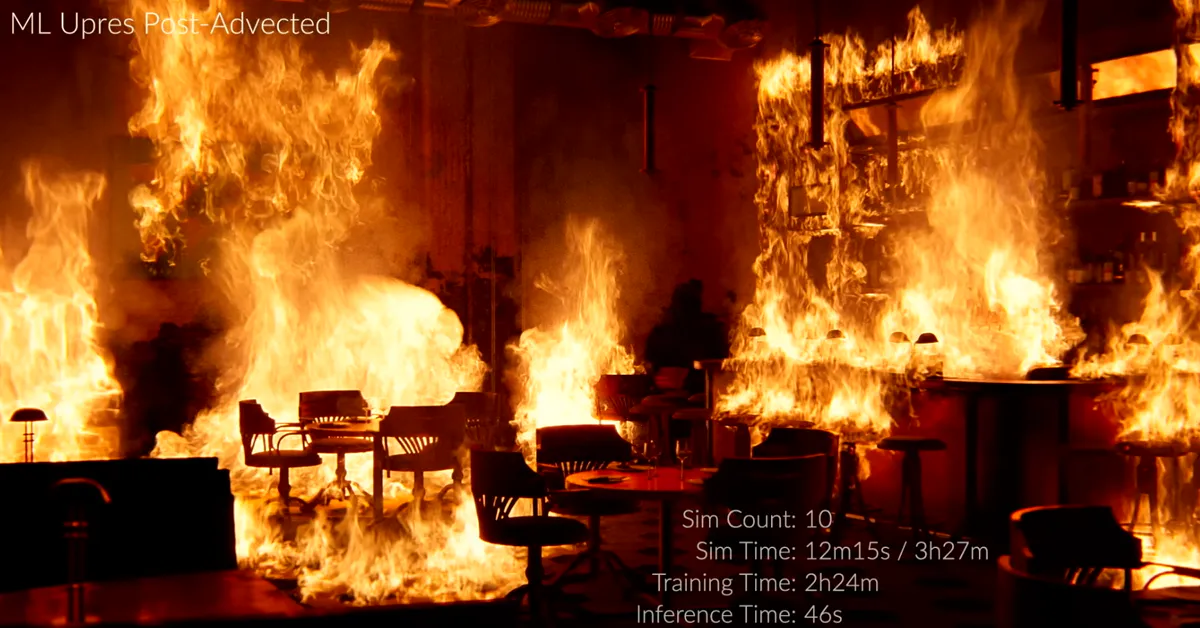
The Hybrid Solver: We will simulate at a low 'Draft' resolution, and an AI-trained model will 'hallucinate' the high-frequency turbulence and detail.
The Predictive Solve: AI will 'predict' if a simulation is going to fail 50 frames before it happens, allowing for real-time adjustments and eliminating wasted compute time.
Curriculum: Industrial Powerhouse: Dynamics for the 2026 Pipeline
Production-Ready Houdini Simulations (FLIP, Pyro, & POPs)
COURSE_ID: CFX-H21-SIM
CORE_OBJECTIVE: Transitioning from 'Brute Force' simulations to 'Perceptual Efficiency'—delivering high-fidelity cinematic dynamics into real-time environments.
Module 1: The SOP-Centric Solver Paradigm
Focus: Efficiency over DOP-Inertia.
- [1]1.1 SOP Solver Architecture: Encapsulating complex dynamics for the UE 5.7 live-link.
- [2]1.2 The Micro-Kernel override: Using VEX to hijack physics fields.
- [3]1.3 OpenCL Optimization: Hardware acceleration for 10x faster iteration.
Module 2: FLIP Fluids (Hydro-Engineering)
Focus: Mastering large and small-scale liquids for the Spatial Web.
- [1]2.1 Narrow-Band Logic: Reducing computation by 80% with surface-only sims.
- [2]2.2 Non-Newtonian Fluids: Engineering mud, lava, and slime via viscosity fields.
- [3]2.3 VAT 3.0 Bridge: Baking cinematic liquids for real-time Nanite-enabled delivery.
Module 3: Sparse Pyro & Combustion (Volumetric Logic)
Focus: City-scale effects on a single workstation.
- [1]3.1 Sparse Volume Mastery: Controlling dynamic bounds for visual salience.
- [2]3.2 Combustion Math: Using advection and divergence for art-directable explosions.
- [3]3.3 Neural Volumetrics: Preparing Pyro for NeRFs and Gaussian Splatting.
Module 4: POPs & Granular Dynamics (The Data Stream)
Focus: Controlling millions of points with logical precision.
- [1]4.1 POP Grains: Engineering sand, snow, and granular debris.
- [2]4.2 Attribute-Driven Motion: Guiding swarms via curated vector fields.
- [3]4.3 Crowd Integration: Orchestrating agentic behavior at scale.
Module 5: Performance Benchmarks & Engine Delivery
Focus: The 'Last Mile' of FX deployment.
- [1]5.1 Perception-Based Culling: Simulating only what is 100% visible.
- [2]5.2 Engine Parity QC: Ensuring bit-depth consistency in UE 5.7.
- [3]5.3 Digital Sovereignty: Linking sims to Neural Presence Protocol metadata.
Technical Benchmarks for Graduation
Efficiency: Simulation must be under 500MB via VAT/Neural protocols.
Speed: Variant iteration must be under 10 minutes.
Parity: 100% visual match between Houdini Karma and Unreal Engine 5.7.
Logic: Simulation must react to 'Context Data' triggers.
Instructor's Note on "Procedural Sovereignty":In this course, we are not teaching you how to make a wall. We are teaching you how to write the laws of physics that govern every wall that will ever be built in your pipeline. This is the transition from worker to architect.
Frequently Asked Questions
Q: What is the difference between DOPs and SOPs in Houdini 21?
A: DOPs is the traditional 'Black Box' environment. SOPs is the modern, more directable environment where most H21 solvers now reside for faster iteration.
Q: Can these simulations run in real-time in Unreal Engine 5.7?
A: Yes, via Vertex Animation Textures (VAT) or Niagara Fluids. This course covers the bridge for both cinematic and real-time playback.
Q: Do I need a background in physics?
A: An understanding of 'Force,' 'Velocity,' and 'Density' is vital. We teach these through visual geometry to keep it intuitive.
Q: How does Houdini 21 handle VDBs differently?
A: H21 is optimized for OpenVDB 11.0, providing faster read/write speeds and better integration with GPU-based rendering (Karma XPU).
Join the Technical Lab
Ready to master the procedural standard? Enroll in the next Great Escape cohort and secure your position in the architectural frontier.